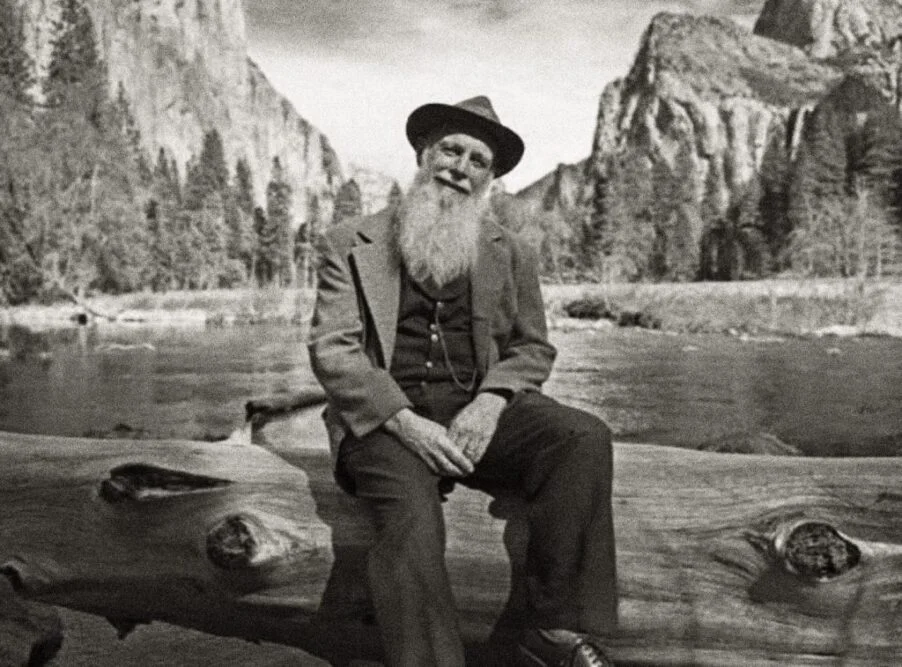
John Muir was a Scottish-American naturalist, writer, and pioneer of environmental conservation, fundamental to the birth of national parks.
We are told that the world was created specifically for man - a conjecture not supported by facts. Numerous men remain unpleasantly surprised when they find in the divine universe something, whether alive or dead, that they cannot somehow eat or, as they say, make useful for their purposes. They have a precise dogmatic understanding of the Creator's intentions, and it is almost impossible to feel guilty when speaking irreverently of their God, just as when we speak of pagan idols. For these people, God is a civilized gentleman and a law-abiding citizen, in favor of either a republican form of government or a limited monarchy. He believes in the language and literature of England, and is a fervent supporter of the English constitution, Sunday schools, and missionary societies - in short, he is a purely manufactured article like any puppet from a cheap puppet show.
Given such ways of understanding the Creator, it is no surprise that erroneous views about creation may exist. For these orderly people, the existence of sheep, for example, is an easily solvable enigma: food and clothing "for us"; they eat grass and white daisies by divine appointment, based on their predestined purpose, a purpose originating from the perception of needing wool after eating the apple in the Garden of Eden.
In this same pleasant scheme, whales are for us stores of oil - to help the stars illuminate our dark paths, at least until the discovery of oil wells in Pennsylvania. Among plants, hemp, not to mention grains, is a clear case of evident predestination to create ropes, packaging, and tools for hanging criminals. Cotton is another clear case regarding clothing. Iron was created for hammers and plows, and lead for bullets: all designed for us. And the same applies to other handfuls of insignificant things.
But we should ask these deep connoisseurs of God's intentions: how to explain those animals that eat men - lions, tigers, alligators - and lick their lips while eating a raw man? Or the myriad of harmful insects that destroy man's work and drink his blood? Was it really intended that man should serve as food and drink for these animals? Oh no! Absolutely not! These are insurmountable difficulties arising from the apple of Eden and the Devil. Why does water drown its master? Why do so many minerals poison him? Why are so many plants and fish such deadly enemies? Why is the lord of creation subject to the same laws of life as the beings subject to him? Oh, all these things are satanic, or somehow connected with the primordial garden. Moreover, these insightful masters do not seem to have ever considered the fact that the goal of Nature in creating animals and plants was first and foremost the happiness of each being, and not the creation of all beings for the happiness of one alone.
Why should man think himself more than a small part of the one great whole of creation? And which creature among the others generated with great effort by God would not be essential to the completeness of that whole - the cosmos? The universe would be incomplete without man, but it would equally be incomplete without the smallest trans-microscopic creature that exists beyond our deceptive eyes and our knowledge.
From the dust of the earth, from the elementary common ground, the Creator has drawn Homo sapiens. From the same material, He has generated every other creature, no matter how harmful or insignificant it may be to us. These creatures are our companions, born from the earth, and like us, mortal beings. Those who, in the midst of this intricate patchwork of modern civilization, are so good and so orthodox as to be almost frightening, begin to shout "heresy" as soon as they see someone showing even the slightest sympathy for beings not belonging to our species. Not content with having appropriated the earth, they also claim the heavenly realms, as if they were the only ones possessing the kind of soul for which this unmeasurable empire was intended.
This star, our good earth, has made many successful journeys around the skies before man was created, and entire realms of creatures have enjoyed life and returned to dust before man appeared to claim them. After humans have played their part in the Creator's plan, it may also be their turn to disappear without the need for any general conflagration and without creating any extraordinary commotion.
Plants are attributed vague and uncertain sensations, and minerals absolutely none. But who tells us that minerals cannot experience sensations of some kind, sensations with which we, in our exclusive perfection, have no chance of coming into contact?
But I have strayed from my subject. A page or two back, I stated that man claims the earth was made for him, and I was intending to say that the fierce beasts, thorny plants, and deadly diseases present in some parts of the earth instead prove that the whole world was not made for man. When an animal from a tropical climate is brought to high latitudes, it may die of cold, and then we would say that this animal was not made for such a harsh climate. But when a man ventures into tropical areas full of diseases, and there finds death, he does not realize that he was not made for such lethal environments. No, he will blame primordial mother for being the cause of this difficulty, even though she has never seen an area affected by fever, or he will consider it a providential punishment for some form of sin of his own invention.
Moreover, all inedible and uncivilized animals, and all thorny plants, are deplorable evils which, according to careful research conducted by the clergy, require to be cleansed from the world through universal and planetary combustion. But more than anything else in the world
it is humanity that needs to be burned, as it is largely wicked, and if that trans-world furnace can be employed and regulated to melt and purify us in accordance with the rest of the earthly creatures, then the tofetization of the erratic genius of Homo would be a conclusion for which to pray fervently. But, glad to leave these ecclesiastical fires and dazzlements, I return joyfully to the immortal truth and the immortal beauty of Nature.

Matteo Stella
Esploratore, guida MTB, Accompagnatore di Media Montagna.

Valle d'Aosta, Italia
Il Trekking dei Giganti: l’Alta via n 1 della Valle d’Aosta
Valle d'Aosta, Italia
Col Croce & Lago d'Arpy Ebike

Valle d'Aosta
Scarpe da Trekking: Alte o Basse? La Guida Definitiva (e il ruolo chiave delle calze)

Valle d'Aosta